Dominica Taxes Explained: A Complete Guide for Citizenship by Investment Applicants
Thinking about obtaining Dominica citizenship by investment? One of the most common concerns among investors is taxation.
Many prospective applicants ask whether acquiring a Dominica passport means they will have to pay income tax, wealth tax, or taxes on their global assets.
The short answer is no.
However, understanding the difference between citizenship and tax residency is essential before making any investment decision.
This guide explains everything you need to know about the tax system in the Commonwealth of Dominica, including personal income tax, corporate taxation, capital gains, inheritance, VAT, and how taxes apply to Citizenship by Investment (CBI) applicants.
Does Getting Dominica Citizenship Mean You Pay Taxes?
No.
Obtaining Dominica citizenship does not automatically make you liable for taxes in Dominica.
This is one of the biggest misconceptions surrounding Citizenship by Investment programs.
Holding a Dominica passport simply grants you citizenship. It does not automatically make you a tax resident of the country.
Your tax obligations are generally determined by your tax residency, not your nationality.
Citizenship vs. Tax Residency
It is important to distinguish between these two legal concepts.
Citizenship
Citizenship gives you rights such as:
- A Dominica passport
- The right to live in Dominica
- The ability to pass citizenship to future generations (subject to applicable laws)
- Visa-free or visa-on-arrival travel to numerous destinations
Citizenship alone does not create tax residency.
Tax Residency
Tax residency depends on where you actually live and where your economic ties are established.
Factors commonly considered include:
- Number of days spent in a country
- Permanent residence
- Centre of economic interests
- Domestic tax legislation
For example, if you obtain Dominica citizenship but continue living and working in Dubai, Türkiye, Saudi Arabia, or another country, you will generally remain subject to that country's tax rules rather than Dominica's.
Who Pays Taxes in Dominica?
Generally speaking, individuals who become tax residents of Dominica may become subject to its tax laws.
Simply owning a Dominica passport while living abroad does not normally create tax obligations in Dominica.

Personal Income Tax in Dominica
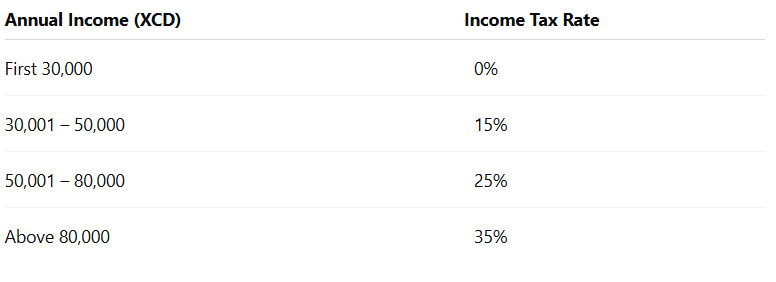
For tax residents, Dominica applies a progressive personal income tax system.
The current tax brackets are approximately:
Is Foreign Income Taxed?
This depends on your tax residency.
If you are not a tax resident of Dominica:
Your foreign income is generally not taxable in Dominica simply because you hold Dominica citizenship.
If you become a tax resident:
The tax treatment of foreign income may vary depending on:
- The source of income
- Applicable tax legislation
- Available exemptions
- International tax agreements
Professional tax advice is always recommended for individual circumstances.
Corporate Income Tax
Companies operating under Dominica's standard corporate tax regime are generally subject to a 25% Corporate Income Tax on net taxable profits.
The applicable tax treatment may differ depending on:
- Business structure
- Nature of activities
- Source of income
- Applicable legislation
Every business should obtain professional tax advice before establishing operations.
Does Dominica Have Capital Gains Tax?
One of the attractive features of Dominica's tax system is that it generally does not impose a separate Capital Gains Tax on the sale of investments or capital assets.
Certain commercial transactions may be treated differently if they form part of ordinary business activities.
Is There an Inheritance Tax?
No.
Dominica does not impose a general inheritance tax.
Is There a Wealth Tax?
No.
There is currently no annual wealth tax in Dominica.
Does Dominica Have a Gift Tax?
Dominica does not operate a general gift tax system similar to those found in certain other jurisdictions.
Property Taxes
Property transactions may involve government fees, transfer duties, and registration charges.
However, Dominica does not impose the type of high annual property taxes found in many countries.
Value Added Tax (VAT)
The standard Value Added Tax (VAT) rate in Dominica is:
15%
Reduced rates may apply to certain sectors in accordance with applicable legislation.
If I Live in Another Country, Which Taxes Apply?
This is one of the most important questions for Citizenship by Investment applicants.
Your tax obligations generally depend on where you live, not which passport you hold.
For example:
- A Dominica citizen living in the United Arab Emirates will generally follow UAE tax regulations.
- A Dominica citizen living in Türkiye will generally be subject to Turkish tax laws.
- A Dominica citizen living in the United Kingdom will generally remain subject to UK tax rules.
Simply obtaining Dominica citizenship does not transfer your tax residency to Dominica.
Is Dominica Considered a Tax Haven?
Dominica is often viewed as having a tax-friendly environment due to several features of its tax system.
Some of the key advantages include:
- No automatic tax residency through citizenship
- No general wealth tax
- No general inheritance tax
- No separate capital gains tax in most situations
- Competitive corporate tax rate
- Straightforward tax system
However, every individual's tax situation depends on their country of residence and personal circumstances.
Frequently Asked Questions
Do I have to move to Dominica after obtaining citizenship?
No.
There is no requirement to relocate in order to maintain your citizenship.
Will I automatically become a tax resident?
No.
Citizenship and tax residency are different legal concepts.
Will my worldwide income be taxed by Dominica?
Not simply because you obtained Dominica citizenship.
Taxation depends on whether you become a tax resident under Dominica's tax laws.
Can I keep living in my current country?
Yes.
Most Citizenship by Investment applicants continue living and operating their businesses in their current country of residence.
Final Thoughts
For most investors, obtaining Dominica Citizenship by Investment does not create new tax obligations in Dominica simply because they receive a Dominica passport.
Instead, taxation is generally determined by tax residency, not citizenship.
Understanding this distinction helps investors make informed decisions while avoiding one of the most common misconceptions about second citizenship.
As every individual's circumstances are different, professional tax advice should always be obtained before making decisions relating to residency, taxation, or international business structures.
Disclaimer
This article is provided for general informational purposes only and should not be considered legal, tax, or financial advice.
Tax legislation may change over time, and each individual's circumstances are unique. Readers are encouraged to consult qualified legal or tax professionals before making decisions based on the information provided.
Related Articles

Dubai Real Estate Outlook After Recent Events: Are We Entering a Smarter Opportunity Phase?
Recent regional developments have raised important questions among investors and buyers alike:
What’s next for Dubai’s real estate market? And is this the right time to invest?
Following the announcement of a ceasefire, market sentiment has begun to stabilize. However, understanding the real impact on Dubai real estate requires a deeper look at economic fundamentals, investor psychology, and market dynamics.
In this article, we provide a realistic, data-driven perspective on what to expect in the coming months.

Dominica Citizenship by Investment Program
Obtaining a second citizenship has become a strategic decision for global investors, entrepreneurs, and families seeking mobility, financial security, and international opportunities. One of the most attractive and affordable options available today is the Dominica Citizenship by Investment Program (CBI).
Established in 1993, Dominica’s program is one of the most reputable and longest-running citizenship by investment programs in the world. It offers investors and their families the opportunity to obtain a second passport in as little as 4–6 months, with access to more than 150 countries visa-free.
This guide explains everything you need to know about the Dominica citizenship program, including investment options, eligibility requirements, benefits, required documents, and the application process.

Escrow Accounts in Dubai: How They Protect Your Real Estate Investment
Dubai has become one of the world’s most attractive destinations for real estate investors. With strong government regulations, clear processes, and transparent systems, property buyers often ask: Is real estate investment in Dubai safe? One of the key answers lies in the Escrow account system. This article explains what an Escrow account is, how it protects buyers, and why it plays a major role in reducing risk in Dubai’s property market.
Comments (0)
You need to be logged in to comment